


Uncovering the Triadic Relationship: IC, Profitability, and Sustainability Reporting in Southeast Asian Companies
Article Sidebar
Main Article Content
Abstract
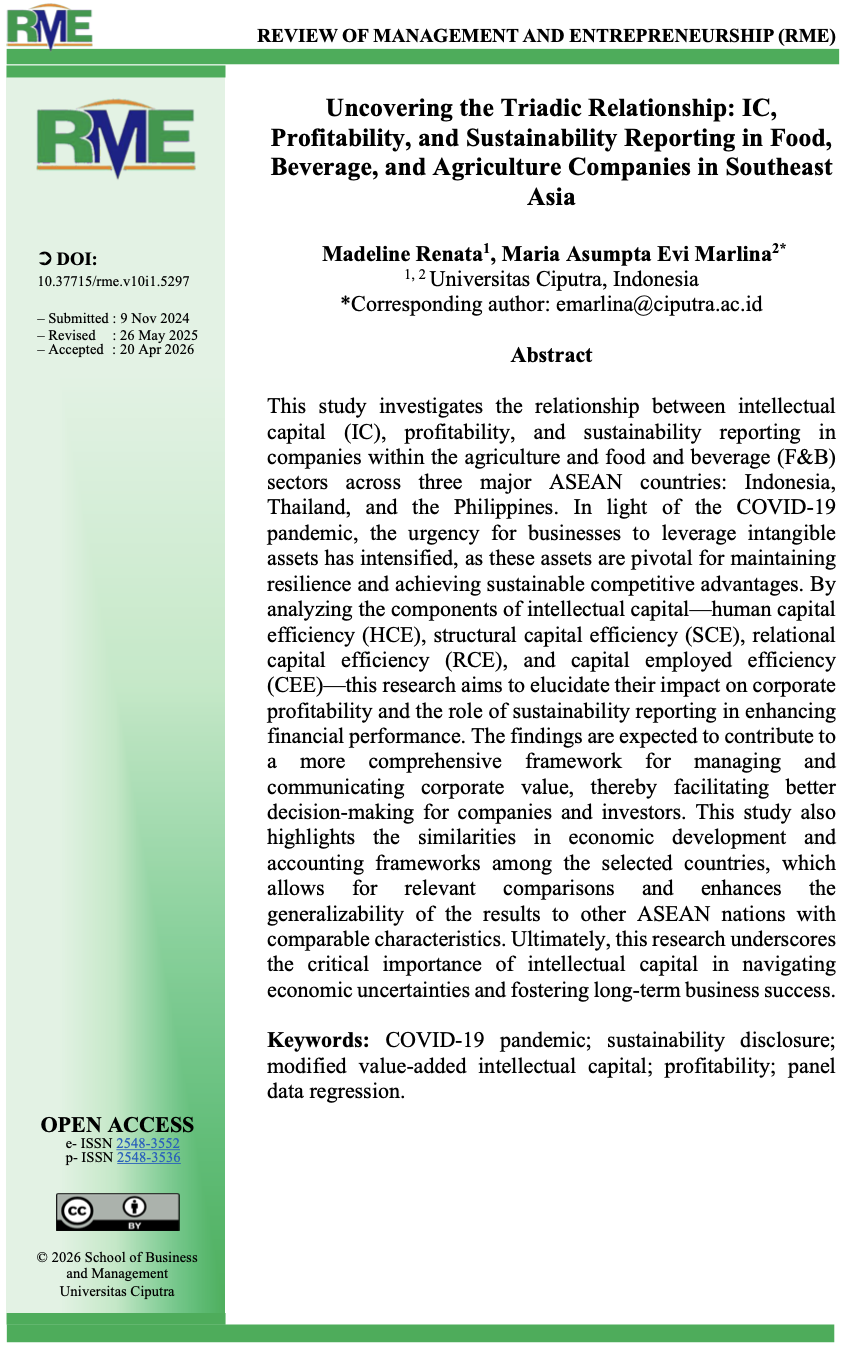
This study investigates the relationship between intellectual capital (IC), profitability, and sustainability reporting in companies within the agriculture and food and beverage (FnB) sectors across three major ASEAN countries: Indonesia, Thailand, and the Philippines. In light of the COVID-19 pandemic, the urgency for businesses to leverage intangible assets has intensified, as these assets are pivotal for maintaining resilience and achieving sustainable competitive advantages. By analyzing the components of intellectual capital—human capital efficiency (HCE), structural capital efficiency (SCE), relational capital efficiency (RCE), and capital employed efficiency (CEE)—this research aims to elucidate their impact on corporate profitability and the role of sustainability reporting in enhancing financial performance. The findings are expected to contribute to a more comprehensive framework for managing and communicating corporate value, thereby facilitating better decision-making for companies and investors. This study also highlights the similarities in economic development and accounting frameworks among the selected countries, which allows for relevant comparisons and enhances the generalizability of the results to other ASEAN nations with comparable characteristics. Ultimately, this research underscores the critical importance of intellectual capital in navigating economic uncertainties and fostering long-term business success.
Article Details

This work is licensed under a Creative Commons Attribution 4.0 International License.
References
Altarawneh, D. I., & Box, P. O. (2017). Effect of Intellectual Capital on Competitive Advantage in the Jordanian Pharmaceutical Companies.
Amran, A., Abbasi, M. A., Foroughi, B., & Tanggamani, V. (2024). Sustainability Reporting, Corporate Reputation, and Firm Performance: Moderating Role of Third-Party Assurance. Corporate Reputation Review. https://doi.org/10.1057/s41299-024-00185-3
ASEAN. (2022). The Asean: Asean Revs Up Digital Transformation. ASEAN. https://asean.org/wp-content/uploads/2022/11/Issue-23-Digital-Transformation-digital-version.pdf
Assensoh-Kodua, A. (2019). The resource-based view: A tool of key competency for competitive advantage. Problems and Perspectives in Management, 17(3), 143–152. https://doi.org/10.21511/ppm.17(3).2019.12
Astari, R. K., & Darsono, D. (2020). PENGARUH INTELLECTUAL CAPITAL TERHADAP KINERJA PERUSAHAAN. Diponegoro Journal of Accounting, 9(2), Article 2. https://ejournal3.undip.ac.id/index.php/accounting/article/view/27588
Bontis, N., Chua Chong Keow, W., & Richardson, S. (2000). Intellectual capital and business performance in Malaysian industries. Journal of Intellectual Capital, 1(1), 85–100. https://doi.org/10.1108/14691930010324188
Bronzetti, G., Rija, M., Sicoli, G., & Ippolito, D. (2023). Disclosure of innovation on sustainability report. European Journal of Innovation Management, 26(3), 885–907. https://doi.org/10.1108/EJIM-04-2021-0195
Chen, M., Cheng, S., & Hwang, Y. (2005). An empirical investigation of the relationship between intellectual capital and firms’ market value and financial performance. Journal of Intellectual Capital, 6(2), 159–176. https://doi.org/10.1108/14691930510592771
Deloitte. (2024). Indonesia [Jurisdiction]. Deloitte. https://www.iasplus.com/en/jurisdictions/asia/indonesia
Diyanty, V., Restuti, M. D., Diyanti, V., & Shauki, E. R. (2019). Intellectual Capital and Firm Performance: Applying a Modified Value-Added Coefficient. 114–123. https://doi.org/10.2991/apbec-18.2019.16
Eccles, R. G., Ioannou, I., & Serafeim, G. (2014). The Impact of Corporate Sustainability on Organizational Processes and Performance (SSRN Scholarly Paper No. 1964011). https://doi.org/10.2139/ssrn.1964011
FAO. (2024). The Philippines | MOSAICC | Food and Agriculture Organization of the United Nations. https://www.fao.org/in-action/mosaicc/on-the-ground/the-philippines/en/
Fernandez-Feijoo, B., Romero, S., & Ruiz, S. (2014). Effect of Stakeholders’ Pressure on Transparency of Sustainability Reports within the GRI Framework. Journal of Business Ethics, 122(1), 53–63. https://doi.org/10.1007/s10551-013-1748-5
Firer, S., & Mitchell Williams, S. (2003). Intellectual capital and traditional measures of corporate performance. Journal of Intellectual Capital, 4(3), 348–360. https://doi.org/10.1108/14691930310487806
Fitriaty, F., Saputra, M. H., & Elliyana, D. (2022). THE EFFECT OF INTELLECTUAL CAPITAL ON COMPANY PERFORMANCE AND COMPANY VALUE BEFORE AND DURING COVID-19 PANDEMIC. JOURNAL OF BUSINESS STUDIES AND MANGEMENT REVIEW, 5(2), Article 2. https://doi.org/10.22437/jbsmr.v5i2.18555
FSRSC. (n.d.). Our Standards—Governmental Organization in the Philippines. Financial and Sustainability Reporting Standards Council. Retrieved September 28, 2024, from https://www.pfsrsc.org/government-organization-our-standards
Gareis, J., & Mayer, E. (2023). Financial shocks and the relative dynamics of tangible and intangible investment: Evidence from the euro area. Macroeconomic Dynamics, 27(5), 1455–1480. https://doi.org/10.1017/S136510052200030X
Gupta, K., Goel, S., & Bhatia, P. (2020). Intellectual Capital and Profitability: Evidence from Indian Pharmaceutical Sector. Vision, 24(2), 204–216. https://doi.org/10.1177/0972262920914108
Hasan, E., Smit, S., Woetzel, L., Cvetanovski, B., Krishnan, M., Gregg, B., Perrey, J., & Hjartar, K. (2021). Getting tangible about intangibles: The future of growth and productivity? | McKinsey. McKinsey Global Institute. https://www.mckinsey.com/capabilities/growth-marketing-and-sales/our-insights/getting-tangible-about-intangibles-the-future-of-growth-and-productivity
HBR. (2023, May 31). The Food and Beverage Sector Needs to Embrace Digital Transformation to Achieve Sustainability Goals—SPONSOR CONTENT FROM SCHNEIDER ELECTRIC. Harvard Business Review. https://hbr.org/sponsored/2023/05/the-food-and-beverage-sector-needs-to-embrace-digital-transformation-to-achieve-sustainability-goals
Herremans, I. M., Nazari, J. A., & Mahmoudian, F. (2016). Stakeholder Relationships, Engagement, and Sustainability Reporting. Journal of Business Ethics, 138(3), 417–435. https://doi.org/10.1007/s10551-015-2634-0
IFRS. (2024). IFRS - View Jurisdiction [Jurisdiction]. IFRS. https://www.ifrs.org/use-around-the-world/use-of-ifrs-standards-by-jurisdiction/view-jurisdiction/thailand/
Inrico, I., Sulastri, S., & Malinda, S. (2023). The effect of working capital management and intellectual capital on firm performance in food and beverages industry listed in Indonesia stock exchange. International Journal of Business, Economics and Management, 6(3), Article 3. https://doi.org/10.21744/ijbem.v6n3.2152
Jin, G., & Xu, J. (2022). Does Intellectual Capital Affect Financial Leverage of Chinese Agricultural Companies? Exploring the Role of Firm Profitability. Sustainability, 14(5), 2682. https://doi.org/10.3390/su14052682
KPMG. (2020, September 22). Digital acceleration—KPMG United States. KPMG. https://kpmg.com/us/en/home/insights/2020/09/digital-acceleration.html
Kujansivu, P., & Lönnqvist, A. (2007). Investigating the value and efficiency of intellectual capital. Journal of Intellectual Capital, 8(2), 272–287. https://doi.org/10.1108/14691930710742844
Mohammad, H. S. (2022). Capital and Profitability: Evidence. 17(1).
Mohammad, H. S., & Bujang, I. (2019). Performance of Malaysian Financial Firms: An Intellectual Capital Perspective Using MVAIC Model. Asian Economic and Financial Review, 9(7), 752–765. https://doi.org/10.18488/journal.aefr.2019.97.752.765
Molthar, D. M., & Indarti, N. (2021). Do All Intellectual Capital Dimension Affects Innovation Capability? (Evidence from Indonesian Food and Beverage Industry). KINERJA, 25(1), 121–141. https://doi.org/10.24002/kinerja.v25i1.4208
Mondal, A., & Ghosh, S. K. (2012). Intellectual capital and financial performance of Indian banks. Journal of Intellectual Capital, 13(4), 515–530. https://doi.org/10.1108/14691931211276115
Nimtrakoon, S. (2015). The relationship between intellectual capital, firms’ market value and financial performance. Journal of Intellectual Capital, 16(3), 587–618. https://doi.org/10.1108/JIC-09-2014-0104
Ozkan, N., Cakan, S., & Kayacan, M. (2017). Intellectual capital and financial performance: A study of the Turkish Banking Sector. Borsa Istanbul Review, 17(3), 190–198. https://doi.org/10.1016/j.bir.2016.03.001
Pertiwi, A., & Budiarti, L. (2023). Does Sustainability Reports Affect Firm Value ? Evidence of Energy and Manufacturing Sector Companies in Indonesia. Proceeding of International Students Conference on Accounting and Business, 2(1), Article 1. https://jp.feb.unsoed.ac.id/index.php/scoab/article/view/3617
Purwanto, P., & Mela, N. F. (2021). PENGARUH MODAL INTELEKTUAL DAN KEUNGGULAN BERSAING TERHADAP KINERJA KEUANGAN. CURRENT: Jurnal Kajian Akuntansi Dan Bisnis Terkini, 2(2), Article 2. https://doi.org/10.31258/jc.2.2.339-362
Suherman, R. (2017). The Impact of Intellectual Capital toward Firm’s Profitability and Market Value of Retail Companies Listed in Indonesia Stock Exchange (IDX) from 2013-2016. iBuss Management, 5(1), Article 1. https://publication.petra.ac.id/index.php/ibm/article/view/5877
Suksarmrong, S., Dampitakse, K., & Ngudgratoke, S. (2023). The Moderating Role of Sustainability Disclosure on the Relationship between Intellectual Capital and Firm Performance. WSEAS TRANSACTIONS ON ENVIRONMENT AND DEVELOPMENT, 19, 272–289. https://doi.org/10.37394/232015.2023.19.24
Sydler, R., Haefliger, S., & Pruksa, R. (2014). Measuring intellectual capital with financial figures: Can we predict firm profitability? European Management Journal, 32(2), 244–259. https://doi.org/10.1016/j.emj.2013.01.008
Tarigan, E. S., & Septiani, A. (2017). PENGARUH INTELLECTUAL CAPITAL TERHADAP KINERJA KEUANGAN PERUSAHAAN SEKTOR KEUANGAN YANG TERDAFTAR DI BURSA EFEK INDONESIA TAHUN 2013-2015. Diponegoro Journal of Accounting, 6(3), Article 3.
Tarigan, J., Listijabudhi, S., Hatane, S. E., & Widjaja, D. C. (2019). The Impacts of Intellectual Capital on Financial Performance: An Evidence From Indonesian Manufacturing Industry. Indonesian Journal of Business and Entrepreneurship (IJBE), 5(1), Article 1. https://doi.org/10.17358/ijbe.5.1.65
Tiwari, R. (2022). Nexus between intellectual capital and profitability with interaction effects: Panel data evidence from the Indian healthcare industry. Journal of Intellectual Capital, 23(3), 588–616. https://doi.org/10.1108/JIC-05-2020-0137
Uddin, M. R., Hasan, M. M., & Abadi, N. (2022). Do intangible assets provide corporate resilience? New evidence from infectious disease pandemics. Economic Modelling, 110, 105806. https://doi.org/10.1016/j.econmod.2022.105806
Ulum, I., Kharismawati, N., & Syam, D. (2017). Modified value-added intellectual coefficient (MVAIC) and traditional financial performance of Indonesian biggest companies. International Journal of Learning and Intellectual Capital, 14(3), 207. https://doi.org/10.1504/IJLIC.2017.086390
Vetchagool, W. (2022). The Effect of Intellectual Capital on Firm Profitability and Efficiency: Evidence from Thai Listed Companies in the Agriculture and Food Industry. Asia Social Issues, 16(1), e253049. https://doi.org/10.48048/asi.2023.253049
Wahyuni, S., Pujiharto, P., Pratama, B. C., & Azizah, S. N. (2023). Analysis of the rate of growth of intellectual capital ability in predicting present and future profitability of Sharia commercial banks in Indonesia. Asian Journal of Accounting Research, 8(2), 194–206. https://doi.org/10.1108/AJAR-10-2021-0226
Wang, M.-C. (2017). The Relationship between Firm Characteristics and the Disclosure of Sustainability Reporting. Sustainability, 9(4), Article 4. https://doi.org/10.3390/su9040624
WEF. (2024, January 12). How ASEAN is building trust in its digital economy | World Economic Forum. https://www.weforum.org/agenda/2024/01/asean-building-trust-digital-economy/
Weqar, F., Khan, A. M., & Haque, S. M. I. (2020). Exploring the effect of intellectual capital on financial performance: A study of Indian banks. Measuring Business Excellence, 24(4), 511–529. https://doi.org/10.1108/MBE-12-2019-0118
WIPO. (2024, June 25). World Intangible Investment Highlights—Better Data for Better Policy—World Intangible Investment Highlights. World Intangible Investment Highlights - Better Data for Better Policy. https://www.wipo.int/web-publications/world-intangible-investment-highlights-better-data-for-better-policy/en/world-intangible-investment-highlights.html
Xu, J., & Li, J. (2019). The impact of intellectual capital on SMEs’ performance in China. Journal of Intellectual Capital, 20(4), 488–509. https://doi.org/10.1108/JIC-04-2018-0074
Zéghal, D., & Maaloul, A. (2010). Analysing value added as an indicator of intellectual capital and its consequences on company performance. Journal of Intellectual Capital, 11(1), 39–60. https://doi.org/10.1108/14691931011013325