


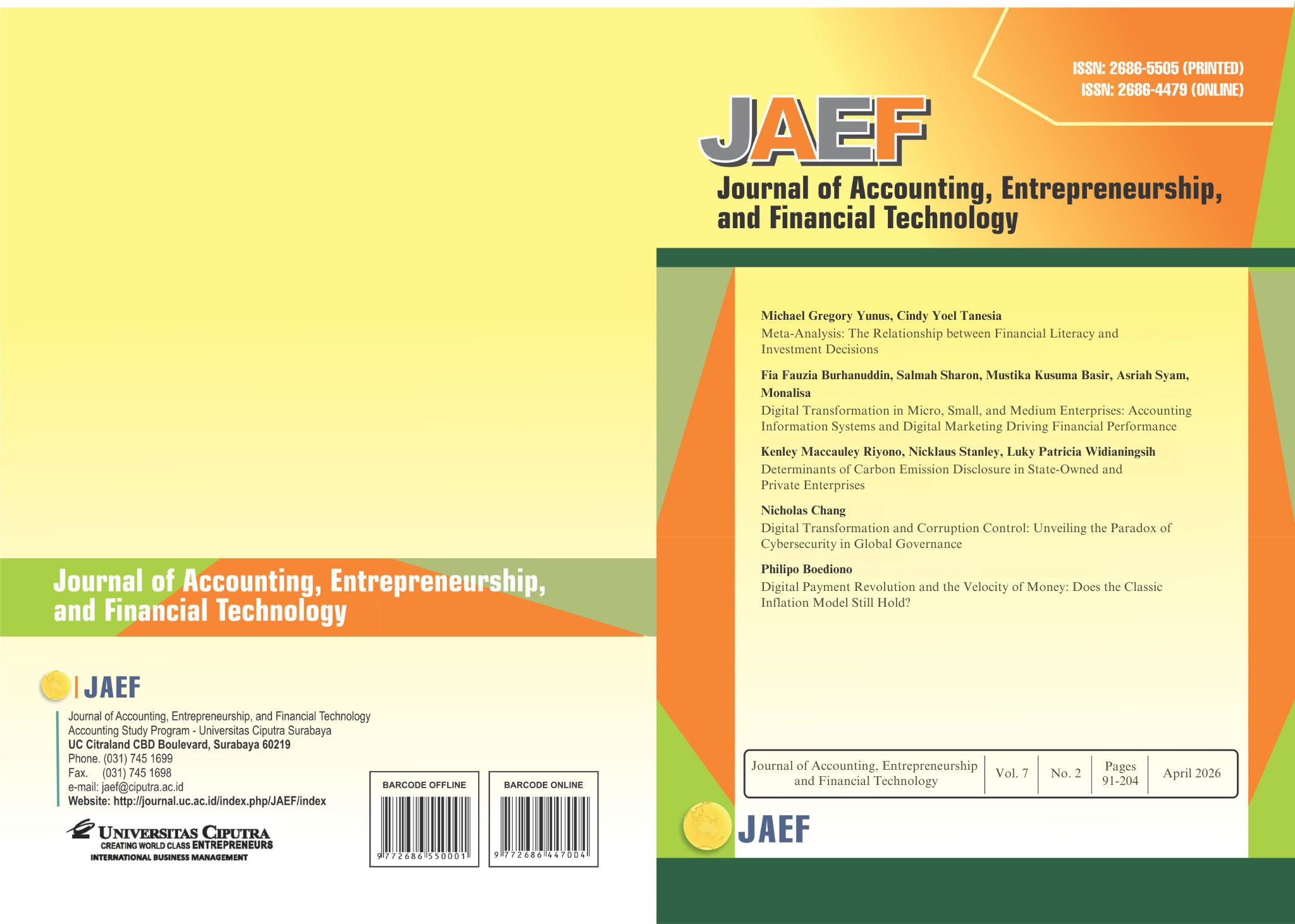
Digital Transformation and Corruption Control: Unveiling the Paradox of Cybersecurity in Global Governance
Article Sidebar
Main Article Content
Abstract
This study examines the association between digital transformation, represented by blockchain, e-government, and cybersecurity, and corruption, proxied by the Corruption Perceptions Index (CPI), within the framework of good governance and Sustainable Development Goal 16. Using a quantitative approach, this study analyzes secondary data from 23 countries characterized by relatively high levels of blockchain adoption. Multiple linear regression analysis was employed using SPSS version 27. The results indicate that blockchain and e-government are positively and significantly associated with CPI, suggesting that higher levels of digital readiness tend to coincide with lower perceived corruption within the sample. E-government shows the strongest association within the model, which is consistent with its potential relevance to transparency, accountability, and public service efficiency. In contrast, cybersecurity is negatively and significantly associated with CPI, indicating that stronger cybersecurity capacity does not necessarily correspond to lower perceived corruption and may reflect tensions between control and transparency when not supported by appropriate governance frameworks. These findings suggest that digital transformation alone is insufficient to combat corruption. Its effectiveness depends on alignment with good governance principles, particularly transparency and accountability. This study contributes by providing an integrated perspective on digital transformation and offers implications for policymakers in designing balanced digital governance strategies.
Article Details

This work is licensed under a Creative Commons Attribution-ShareAlike 4.0 International License.
References
Aarvik, P. (2020). Blockchain as an Anticorruption Tool. Oslo: CMI.
Abbas, H. S. M., Qaisar, Z. H., Xu, X., & Sun, C. (2022). Nexus of E-government, Cybersecurity and Corruption on Public Service (PSS) Sustainability in Asian Economies Using Fixed-Effect and Random Forest Algorithm. Online Information Review, 46(4), 754–770. https://doi.org/10.1108/OIR-02-2021-0069
Addink, G. H. (2018). Good Governance: Importance in Practice, Theories and Definitions. Halu Oleo Law Review, 1(1), 1–32. https://doi.org/10.33561/holrev.v1i1.2347
Adijaya, V., & Radianto, E. D. W. (2025). Debt, Profit, and Tax: Investigating Corporate Tax Behavior. Journal of Accounting, Entrepreneurship and Financial Technology (JAEF), 7(1), 55–74. https://doi.org/10.37715/jaef.v7i1.6069
Ajibade, P., & Mutula, S. M. (2022). The Use of Blockchain Technology in Electronic Records Management Systems to Mitigate Corruption in South Africa. Mousaion: South African Journal of Information Studies, 39(4), 1–19. https://doi.org/10.25159/2663-659X/10149
Alaa, D., & Misko, O. (2022). The Digitalization and its Influence on Combating Corruption. Public Administration and Civil Service, 1(80), 183–197. https://doi.org/10.52123/1994-2370-2022-570
Arwati, D., & Latif, D. V. (2019). Tingkat Kepercayaan Masyarakat terhadap Transparansi Keuangan dalam E Government Kota Bandung. JBMP (Jurnal Bisnis, Manajemen dan Perbankan), 5(2), 66–74. https://doi.org/10.21070/JBMP.V5I2.2736
Azmi, I. F., & Nugroho, A. A. (2023). Anti-Corruption System 4.0: The Adoption of Blockchain Technology in the Public Sector. Integritas : Jurnal Antikorupsi, 9(1), 93–108. https://doi.org/10.32697/integritas.v9i1.985
Baum, M. A., & Potter, P. B. K. (2019). Media, Public Opinion, and Foreign Policy in the Age of Social Media. Journal of Politics, 81(2), 747–756. https://doi.org/10.1086/702233
Bhaskar, P., Tiwari, C. K., & Joshi, A. (2020). Blockchain in Education Management: Present and Future Applications. Interactive Technology and Smart Education, 18(1), 1–17. https://doi.org/10.1108/ITSE-07-2020-0102
Binus. (2021). Memahami Uji Multikolinearitas dalam Model Regresi – Accounting. https://accounting.binus.ac.id/2021/08/06/memahami-uji-multikolinearitas-dalam-model-regresi.
Bozhenko, V., Boyko, A., & Voronenko, I. (2023). Corruption as an Obstacle of Sustainable Development. Springer Proceedings in Business and Economics, 1, 395–407. https://doi.org/10.1007/978-3-031-28131-0_27
Cagigas, D., Clifton, J., Diaz-Fuentes, D., & Fernandez-Gutierrez, M. (2021). Blockchain for Public Services: A Systematic Literature Review. IEEE Access, 9, 13904–13921. https://d™£oi.org/10.1109/ACCESS.2021.3052019
Dang, T. C., Van, H. V., & Van, D. Le. (2025). E-Government and Corruption in an Emerging Country: New Perspectives from a Spatiotemporal Approach. International Review of Economics & Finance, 100, 104111. https://doi.org/10.1016/J.IREF.2025.104111
Data Reportal. (2025). Digital di Seluruh Dunia. Datareportal. Retrieved 12 April, 2025, from: https://datareportal.com/global-digital-overview
Dobrovolska, O., & Rozhkova, M. (2024). The Impact of Digital Transformation on the Anti-Corruption and Cyber-Fraud System. Business Ethics and Leadership, 8(2), 231–252. https://doi.org/10.61093/bel.8(3).231-252.2024
El Kafhali, S. (2024). Blockchain-Based Electronic Voting System: Significance and Requirements. Mathematical Problems in Engineering, 2024(1), 1–17. https://doi.org/10.1155/2024/5591147
Handoko, R. M., Trisna, B. A. A., Pratama, R. D., & Parhusip, J. (2024). Implementasi Blockchain untuk Keamanan Sistem Pembayaran Digital dan Optimasi Transaksi Keuangan (Studi Kasus Industri Fintech di Indonesia). Teknik: Jurnal Ilmu Teknik dan Informatika, 4(2), 64–74. https://doi.org/10.51903/TEKNIK.V4I2.589
Henley & Partners. (2023). Crypto Wealth Report 2023. Henleyglobal. Retrieved 31 March, 2026, from: https://www.henleyglobal.com/publications/crypto-wealth-report/ crypto-adoption-index.
Hochstetter, J., Vásquez, F., Diéguez, M., Bustamante, A., & Arango-López, J. (2023). Transparency and E-Government in Electronic Public Procurement as Sustainable Development. Sustainability 2023, 15(5), 4672. https://doi.org/10.3390/SU15054672
Hope, K. R. (2020). Peace, Justice and Inclusive Institutions: Overcoming Challenges to the Implementation of Sustainable Development Goal 16. Global Change, Peace and Security, 32(1), 57–77. https://doi.org/10.1080/14781158.2019.1667320
Ilori, O. O., & Tanimowo, F. O. (2022). Heteroscedasticity Detection in Cross-Sectional Diabetes Pedigree Function: A Comparison of Breusch-Pagan-Godfrey, Harvey and Glejser Tests. International Journal of Scientific and Management Research, 05(12), 150–163. https://doi.org/10.37502/IJSMR.2022.51211
Javaid, M., Haleem, A., Singh, R. P., & Suman, R. (2023). Towards Insighting Cybersecurity for Healthcare Domains: A Comprehensive Review of Recent Practices and Trends. Cyber Security and Applications, 1, 100016. https://doi.org/10.1016/J.CSA.2023.100016
Kalesnikaite, V., Neshkova, M. I., & Ganapati, S. (2023). Parsing the Impact of E-Government on Bureaucratic Corruption. Governance, 36(3), 827–842. https://doi.org/10.1111/GOVE.12707
Karina, D., Oh, A., & Hamzah, Z. (2023). Unravelling Factors Shaping Purchase Intention for “Tri” Cellular Card. International Journal of Information System and Innovation Managemen, 1(1), 32–45.
Katrakazas, C., Theofilatos, A., Papastefanatos, G., Härri, J., & Antoniou, C. (2020). Cyber Security and its Impact on CAV Safety: Overview, Policy Needs and Challenges. Advances in Transport Policy and Planning, 5, 73–94. https://doi.org/10.1016/BS.ATPP.2020.05.001
Kim, K., & Kang, T. (2021). Will Blockchain Bring an End to Corruption?: Areas of Applications and Potential Challenges. International Journal of Information Systems and Social Change, 10(2), 35-44. https://doi.org/10.4018/978-1-7998-5351-0.CH100
Lee, K., Malerba, F., & Primi, A. (2020). The Fourth Industrial Revolution, Changing Global Value Chains and Industrial Upgrading in Emerging Economies. Journal of Economic Policy Reform, 23(4), 1-12. https://doi.org/10.1080/17487870.2020.1735386
Li, Y., & Liu, Q. (2021). A Comprehensive Review Study of Cyber-Attacks and Cyber Security; Emerging Trends and Recent Developments. Energy Reports, 7, 8176–8186. https://doi.org/10.1016/J.EGYR.2021.08.126
Lykidis, I., Drosatos, G., & Rantos, K. (2021). The Use of Blockchain Technology in e-Government Services. Computers, 10(12), 168. https://doi.org/10.3390/computers10120168
Malodia, S., Dhir, A., Mishra, M., & Bhatti, Z. A. (2021). Future of E-Government: An Integrated Conceptual Framework. Technological Forecasting and Social Change, 173, 121102. https://doi.org/10.1016/J.TECHFORE.2021.121102
Mamulak, N. M. R., Miswadi, M., Julinaldi, J., Komarudin, R., & Syahputra, M. (2024). Blockchain Technology: Unlocking New Frontiers in Data Management and Transparency. Global International Journal of Innovative Research, 2(9), 2257–2270. https://doi.org/10.59613/GLOBAL.V2I9.328
Mehawesh, S. S., & Al-Badayneh, D. M. (2025). Pakistan Journal of Life and Social Sciences Corruption Perception and Government Effectiveness in Combating Corruption, and Citizens’ Satisfaction. Pakistan Journal of Life and Social Sciences, 23(1), 9075-9081. https://doi.org/10.57239/PJLSS-2025-23.1.00710
Mensah, I. K. (2020). Impact of Government Capacity and E-Government Performance on the Adoption of E-Government Services. International Journal of Public Administration, 43(4), 303–311. https://doi.org/10.1080/01900692.2019.1628059
Mishra, P., Pandey, C. M., Singh, U., Gupta, A., Sahu, C., & Keshri, A. (2019). Descriptive Statistics and Normality Tests for Statistical Data. Annals of Cardiac Anaesthesia, 22(1), 67. https://doi.org/10.4103/ACA.ACA_157_18
Mittelstadt, B. D., Allo, P., Taddeo, M., Wachter, S., & Floridi, L. (2016). The Ethics of Algorithms: Mapping the Debate. Big Data and Society, 3(2), 1-21. https://doi.org/10.1177/2053951716679679
Jafar, M. A. W. (2024). Dampak E-Government dalam Meningkatkan Efisiensi dan Efektivitas Tata Kelola Pemerintahan. Politika Progresif : Jurnal Hukum, Politik Dan Humaniora, 1(4), 204–226. https://doi.org/10.62383/progres.v1i4.1303
Munari. (2024). E-Government Implementation and its Impact on Economic Efficiency Munari AMIK Tridharma Palu. Jurnal Ekonomi, 13(1), 1452–1463. https://doi.org/10.54209/ekonomi.v13i01
Thanh, N. C., Huy, T. P., Pham Hong, T., & Bui Nguyen Quoc, A. (2025). Credit Risk Prediction with Corruption Perception Index: Machine Learning Approaches. Cogent Business and Management, 12(1), 1-14. https://doi.org/10.1080/23311975.2025.2461731
Ningsih, D. A., Nurhasanah, & Fadillah, L. (2019). Efektivitas Pembelajaran di Luar Kelas dalam Pembentukan Sikap Percaya Diri Peserta Didik pada Mata Pelajaran IPA di Kelas V SDN 190 Cenning. Pendidikan Dasar dan Keguruan, 4(2), 1–12.
https://doi.org/10.47435/jpdk.v4i2.314
Nookhao, S., & Kiattisin, S. (2023). Achieving a Successful E-Government: Determinants of Behavioral Intention from Thai Citizens’ Perspective. Heliyon, 9(8), 18944. https://doi.org/10.1016/J.HELIYON.2023.E18944
Normand, Y. (2025). On Blockchain as a Tool Against Corporate Corruption. Northwestern Journal of International Law & Business, 45(2), 235-261. https://scholarlycommons.law.northwestern.edu/njilb/vol45/iss2/3.
Nur, U., Mutiarin, D., Jovita, H. D., Palomares, P. P., & Isolana, J. B. (2025). Role of Good Governance Indicators in Controlling Corruption. Journal of Governance and Public Policy, 12(1), 83–99. https://doi.org/10.18196/jgpp.v12i1.22287
Ohize, H. O., Onumanyi, A. J., Umar, B. U., Ajao, L. A., Isah, R. O., Dogo, E. M., Nuhu, B. K., Olaniyi, O. M., Ambafi, J. G., Sheidu, V. B., & Ibrahim, M. M. (2024). Blockchain for Securing Electronic Voting Systems: A Survey of Architectures, Trends, Solutions, and Challenges. Cluster Computing, 28(2), 132. https://doi.org/10.1007/s10586-024-04709-8
Ølnes, S., Ubacht, J., & Janssen, M. (2017). Blockchain in Government: Benefits and Implications of Distributed Ledger Technology for Information Sharing. Government Information Quarterly, 34(3), 355–364. https://doi.org/10.1016/J.GIQ.2017.09.007
Ramadani, Ri. E., Sofyani, H., & Putra, A. Z. (2023). Faktor-Faktor yang Memengaruhi Kesiapan Pegawai Pemerintah Daerah dalam Mengadopsi Teknologi Blockchain pada Sistem Informasi Akuntansi Manajemen. Jurnal Manajemen Dinamis, 1(2), 109–122. https://doi.org/10.59330/JMD.V1I2.28
Sakhnini, J., Karimipour, H., Dehghantanha, A., & Parizi, R. M. (2021). Physical Layer Attack Identification and Localization in Cyber–Physical Grid: An Ensemble Deep Learning Based Approach. Physical Communication, 47, 101394. https://doi.org/10.1016/J.PHYCOM.2021.101394
Seiam, D. A., & Salman, D. (2024). Examining the Global Influence of E-Governance on Corruption: A Panel Data Analysis. Future Business Journal, 10(1), 29. https://doi.org/10.1186/s43093-024-00319-3
Senarathna, J. I. (2025). The Role of Cryptography in Blockchain: Ensuring Immutability, Transparency and Security. https://doi.org/10.20944/preprints202504.1814.v1
Sohag, K., Riad Shams, S. M., Darusalam, D., & Devalle, A. (2021). Information Digitalisation and Local Institutional Agility: Evidence from ASEAN Countries. Technological Forecasting and Social Change, 172. https://doi.org/10.1016/j.techfore.2021.121063
Sriningsih, M., Hatidja, D., & Prang, J. D. (2018). Penanganan Multikolinearitas dengan Menggunakan Analisis Regresi Komponen Utama pada Kasus Impor Beras di Provinsi Sulut. Jurnal Ilmiah Sains, 18(1), 18–24. https://doi.org/10.35799/jis.18.1.2018.19396
Sugiarti, R., & Akbar, L. R. (2024). The Effect of E-Government on Corruption-International Evidence. Asia Pacific Fraud Journal, 9(2), 165–176. https://doi.org/10.21532/APFJOURNAL.V9I2.324
Sukarno, M., Rodriguez, M. J., & Nursamsiyah, N. (2024). E-Government Development on Control Corruption: A Lesson Learned from Singapore. Journal of Governance and Public Policy, 11(3), 271–286. https://doi.org/10.18196/JGPP.V11I3.21447
Suryayusra, Anjuju, D., Ulfa, M., & Irawan, D. (2025). Analisis Keamanan Infrastruktur Teknologi Informasi dalam Menghadapi Ancaman Cybersecurity. Journal of Data Analytics, Information, and Computer Science (JDAICS), 2(1), 75–80. https://doi.org/10.70248/jdaics.v2i1.1792
Transparency International. (2023). Corruption Perceptions Index 2023. Retrieved 31 March, 2026, from: https://www.transparency.org/en/cpi/2023.
Transparency International. (2024). 2024 Corruption Perceptions Index: Corruption is Playing a Devastating Role in the Climate Crisis. Transparency International. Retrieved 31 March, 2026, from: https://www.transparency.org/en/press/2024-corruption-perceptions-index-corruption-playing-devastating-role-climate-crisis
Trequattrini, R., Palmaccio, M., Turco, M., & Manzari, A. (2024). The Contribution of Blockchain Technologies to Anti-Corruption Practices: A Systematic Literature Review. Business Strategy and the Environment, 33(1), 4–18. https://doi.org/10.1002/BSE.3327
United Nations Development Programme. (1997). Governance for Sustainable Human Development : A UNDP Policy Document. United Nations. Retrieved 31 March, 2026, from: https://digitallibrary.un.org/record/492551?ln=en&v=pdf
Rustiarini, N. W. (2019). The Role of E-Government in Reducing Corruption: A Systematic Review. Jurnal Perspektif Pembiayaan dan Pembangunan Daerah, 7(3), 269–286.
World Bank. (2023a). E-Government Development Index (EGDI). Retrieved 31 March, 2026, from: https://data360.worldbank.org/en/dataset/UN_EGDI.
World Bank. (2023b). Global Cybersecurity Index - Overall Score (ITU GCI). Worldbank. Retrieved 31 March, 2026, from: https://data360.worldbank.org/en/indicator/ITU_GCI_GCI_OVRL_SCRE?.
World Economic Forum. (2020). Blockchain Alone Can’t Prevent Crime, but these 5 Use Cases Can Help Tackle Government Corruption. World Economic Forum. Retrieved 31 March, 2026, from: https://www.weforum.org/stories/2020/07/5-ways-blockchain-could-help-tackle-government-corruption/.
Zubaedah, P. A., Harliyanto, R., Situmeang, S. M. T., Siagian, D. S., & Septaria, E. (2024). The Legal Implications of Data Privacy Laws, Cybersecurity Regulations, and AI Ethics in a Digital Society. The Journal of Academic Science, 1(2), 103-110. https://doi.org/10.59613/29QYPW51